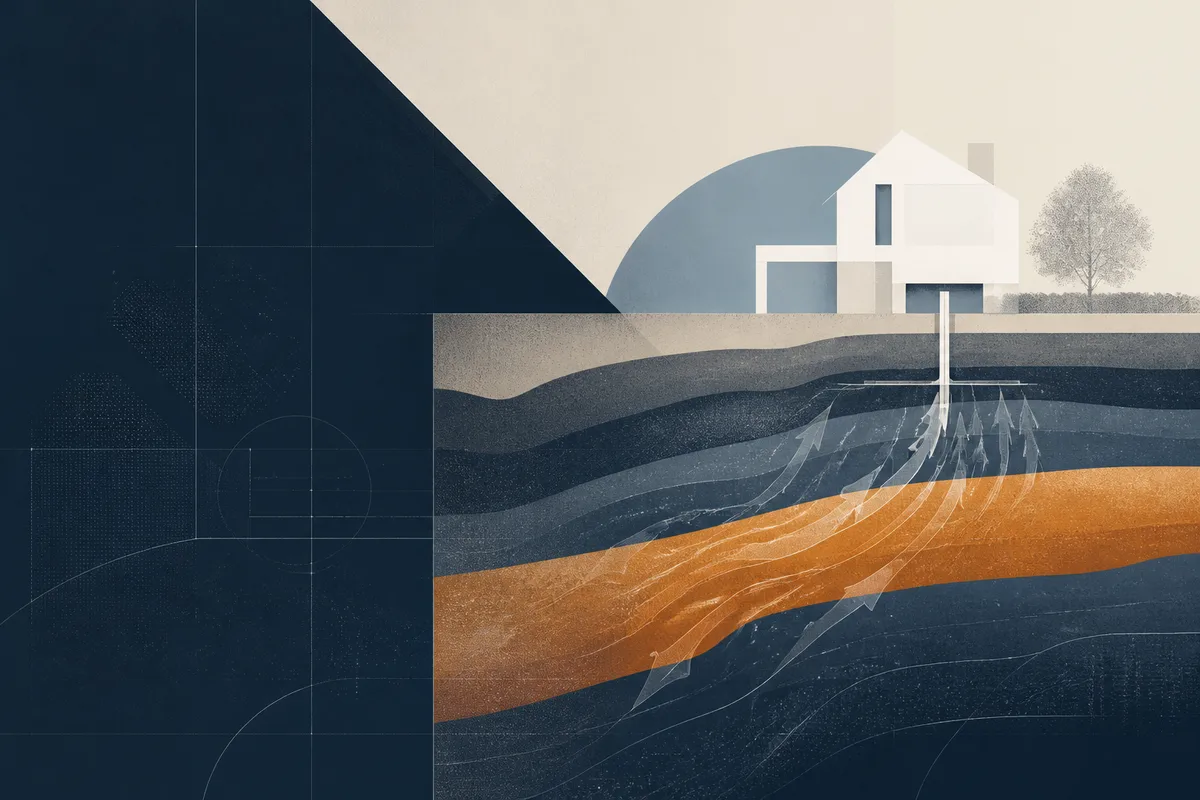
The Subsurface Highway: How Sandstone Formations Facilitate Radon Migration
Soil gas doesn't move through the earth at a uniform pace; it follows the path of least resistance. While dense clay or unweathered granite can trap gas or slow its ascent, porous sedimentary rock provides an ideal conduit for gas movement. Many property owners focus on the "source" of radon, yet the real risk often lies in the "transport" mechanism provided by permeable sandstone and fractured rock.
This guide analyzes the mechanics of soil gas transport in high-permeability zones and why local geology dictates the design of commercial and residential mitigation systems. It is intended for real estate professionals and stakeholders in the region who need to understand why two identical buildings on the same block can return vastly different testing results.
Why Surface-Level Radon Testing Often Conceals Subsurface Risk
Relying on a single snapshot of indoor air quality can be misleading when the local geology is characterized by high permeability. Standard risk assessments often fail to account for the speed at which gas moves through fractured rock gas pathways.
- High-permeability soils allow for a larger "collection area," meaning a building can draw radon from soil much further away than it would in tight clay.
- Atmospheric pressure drops, such as those preceding a storm, can cause sudden "exhalations" of gas from sandstone layers into a basement or crawl space.
- Fractured rock allows radon to bypass traditional soil filters, reaching the foundation before the gas has a chance to decay into its short-lived solid progeny.
- Construction activities or utility trenching can inadvertently create new connections to these deep sandstone highways, altering a building's radon profile years after it was built.
Mechanics of Radon in Sandstone Formations
The behavior of radon in sandstone formations is governed by the physical space between grains and the connectivity of those spaces. Understanding these factors allows for more predictable mitigation outcomes.
1Identify Pore Space Connectivity
Radon moves most efficiently through interconnected pores. In permeable sandstone, high pore connectivity facilitates soil permeability and radon transport via pressure-driven flow rather than simple molecular diffusion.
2Map Fractured Rock Gas Pathways
Beyond simple pore space, secondary permeability occurs through joints, bedding planes, and fractures. These cracks act as express lanes for gas, as radon discharged through faults and fractures can be enhanced by geological activity and pressure differentials.
3Evaluate the Pressure Differential
The "stack effect" in a building creates a vacuum that pulls soil gas inward. In high-permeability sandstone, this suction is highly effective, as the earth offers very little resistance to the air being pulled toward the foundation's entry points.
4Quantify the Source Potential
While transport is key, the rock must contain the precursor elements. Uranium and radium concentrations in surface rocks and soils serve as primary indicators for the potential of radon emissions from the ground.
The Role of Advection vs. Diffusion
In low-permeability soils, radon mostly moves by diffusion—the slow migration from areas of high concentration to low concentration. This process is so slow that much of the radon decays before it ever reaches a crawl space. However, in sandy soils, advection takes over.
Advection is the bulk movement of air caused by pressure differences. When a furnace kicks on or wind blows across a roofline, it creates a pressure drop inside the home. If the house sits on permeable sandstone, the earth acts like a giant sponge filled with gas; the house simply "sucks" that gas out of the sponge. This is why geological impact on radon gas migration is the primary driver of the spikes seen in regional monitoring data.
How Denver Radon Services Approaches Site Evaluation
Addressing radon in high-permeability areas requires a transition from basic localized suction to a broader understanding of sub-slab communication. A typical scope of work for complex geological sites begins with professional radon testing using continuous monitors to track how gas levels fluctuate alongside weather patterns.
In commercial settings or multi-family developments, the strategy often involves commercial radon protocols that include diagnostic pressure field testing. This process determines how far a suction point can "reach" through the sandstone. Because the soil is so permeable, a single high-suction point may protect a significantly larger footprint than it would in heavy clay. To discuss specific site characteristics or schedule a diagnostic evaluation in the Denver area, property owners can call (720) 677-9523 or provide project details at https://denverradonservices.com/.
Frequently asked questions
Does a "passing" radon test mean my property's geology is safe?
A passing test only reflects the conditions during that specific 48-hour window. Because sandstone formations are highly sensitive to barometric pressure changes, a building that passes in high-pressure weather may fail significantly during a low-pressure front when the soil "breathes" more outward.
Why does my neighbor have low radon when I have high levels?
Subsurface geology is rarely uniform. One property may sit directly over a fractured sandstone lens, while a neighbor in Lakewood might be situated over a pocket of dense clay that naturally caps the gas, preventing it from reaching the foundation.
Can I identify sandstone beneath my home without drilling?
Geological survey maps provide a general idea of the formation layers. However, the most practical way to confirm high permeability is through a communication test, which measures how easily air moves beneath the slab when a vacuum is applied.
Are newer homes in Denver more resistant to sandstone gas migration?
Modern energy-efficient homes are often more airtight, which can actually increase the "vacuum" effect on the soil. While newer homes may have better passive venting, the underlying geological impact remains a constant factor that modern construction must specifically account for through active mitigation if the soil is highly permeable.
How does moisture in the sandstone affect gas movement?
Water fills the pore spaces in sandstone, which can slow down radon migration by blocking the gas pathways. Conversely, as the soil dries out during dry seasonal spells, those pathways open up, often leading to higher indoor radon concentrations.
What is the most common failure point for systems in sandy soil?
In highly permeable soil, a common issue is "short-circuiting," where a mitigation system pulls air from a nearby crack in the floor or a sump pit rather than from under the entire slab. Proper sealing of all foundation bypasses is critical to ensure the vacuum is pulling from the soil, not the room.
What happens when you get in touch: you describe the situation, we ask the few questions that actually change the answer, and you get a clear scope and next step — no obligation.